

What Uses the Most Electricity in Your Virginia Home?

When a Virginia homeowner opens the electric bill after a stretch of 90-degree summer days, one question often comes to mind:
Why is my electric bill so high?
You might immediately think about your refrigerator, washer and dryer, dishwasher, television, computers, lights, or all of the devices plugged in around your home.
They all use electricity. But one of the biggest energy users in your home is also one of the most important: Your heating and cooling system.
Here in Virginia, our HVAC systems have a particularly demanding job. We experience hot, humid summers and cold winter temperatures, which means our heating and cooling equipment works hard during both ends of the year.
Understanding where your energy goes — and keeping your HVAC equipment properly maintained — can help you make smarter decisions about your home's comfort and energy costs.
Heating and Cooling Are Major Household Energy Users
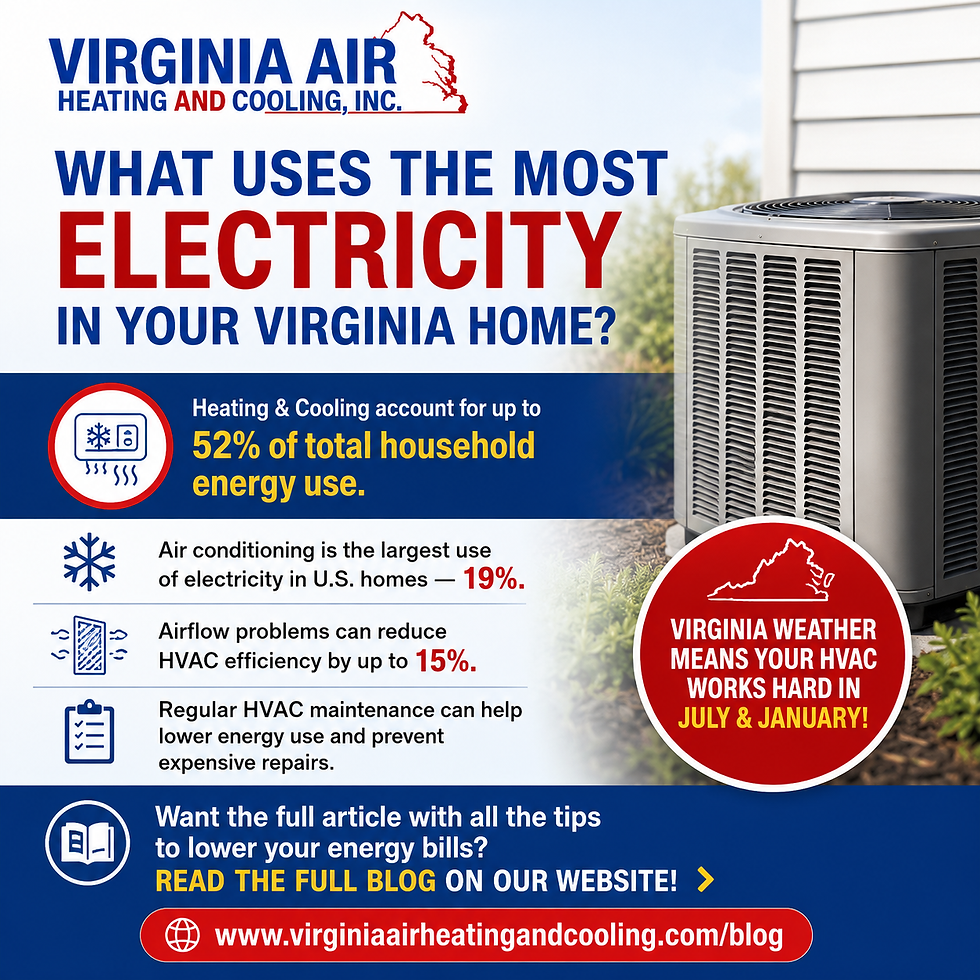
According to the U.S. Energy Information Administration (EIA), space heating and air conditioning combined accounted for approximately 52% of the average U.S. household's total annual energy consumption in 2020.
That's more than half of household energy use.
When looking specifically at electricity, EIA data shows:
Air conditioning — approximately 19%
Space heating — approximately 12%
Water heating — approximately 12%
Together, those three uses accounted for approximately 43% of residential electricity consumption.
For Virginia homeowners, these numbers are especially important because we have both a substantial cooling season and heating season.
Virginia Homes Can Use a Lot of Electricity
Where you live makes a difference in how much electricity your home consumes.
According to the EIA, single-family detached homes in the South consume more electricity annually on average than the other U.S. region and housing-type combinations highlighted by the agency.
There are good reasons for that.
Homes in the South generally use more air conditioning and are more likely to use electricity for heating.
Virginia falls into an interesting climate zone.
We're far enough south to experience long periods of hot, humid summer weather, but we're also far enough north that winter temperatures can get very cold.
That means your HVAC system may be working hard in July and January.
Air Conditioning Is the Largest Single Use of Electricity in U.S. Homes
According to EIA residential energy data, air conditioning accounted for approximately 19% of residential electricity consumption in 2020.
American homes used approximately 254 billion kilowatt-hours of electricity for air conditioning that year.
That's billion with a "B."
And here in Virginia, air conditioning isn't simply about lowering the temperature.
It's also about dealing with humidity.
Your air conditioner removes heat from your home while also helping remove moisture from the indoor air.
When we experience stretches of hot and humid Virginia weather, your air conditioner can operate for long periods trying to maintain comfortable indoor conditions.
Why Does Your AC Use So Much Electricity During a Virginia Summer?
Imagine it's 95°F outside and you're trying to keep your house at 72°F.
Heat is constantly entering your home.
It can enter through:
Windows
Exterior doors
Attic spaces
Walls and ceilings
Air leaks
Poorly insulated areas
Ductwork
Direct sunlight
Your family, lighting, cooking and appliances also generate heat inside the house.
Your air conditioner has to continuously remove that heat while also dealing with indoor humidity.
The hotter and more humid it becomes outside, the harder your system may need to work.
That's why a higher summer electric bill doesn't automatically mean something is wrong with your air conditioner.
But a sudden or unexplained increase in electricity consumption can be worth investigating.
Airflow Problems Can Reduce HVAC Efficiency by Up to 15%
Here's one statistic every homeowner should know.
According to ENERGY STAR, airflow problems can reduce HVAC system efficiency by as much as 15%.
That's significant when you consider how many hours your system may operate during a Virginia summer.
Your HVAC system was designed to move a certain amount of air.
When something restricts that airflow, performance can suffer.
Common causes can include:
Dirty air filters
Dirty evaporator coils
Blower problems
Blocked or closed vents
Ductwork problems
Improperly sized ductwork
A relatively simple airflow problem can cause your system to work harder than necessary.
And when your HVAC equipment works harder, it can consume more energy.
Check Your Air Filter Regularly
One of the easiest things homeowners can do is also one of the easiest things to forget:
Check the HVAC filter.
A dirty filter can restrict airflow through your system.
How frequently should you change it?
There's no single answer that works for every Virginia home.
It depends on factors including:
The type of filter
Number of people in the house
Pets
Household dust
Indoor air quality equipment
Home renovations
How frequently the HVAC system operates
During periods of extreme summer or winter weather, your system may operate considerably more than it does during spring and fall.
That means more air is moving through the filter.
Instead of assuming your filter will always last a certain number of months, change it monthly to avoid forgetting to do so and check it in between changes when the outdoor weather is extreme.
Don't Forget About Your Outdoor AC Unit
Your outdoor air-conditioning unit has an important job.
It's responsible for releasing the heat your air conditioner removed from inside your house.
To accomplish that efficiently, it needs proper airflow.
Virginia summers bring plenty of fast-growing grass, weeds and landscaping.
Keep an eye on the area surrounding your outdoor equipment.
Watch for:
Grass clippings
Leaves
Weeds
Shrubs growing too close
Dirt
Mulch
Other debris
Repeatedly blowing grass clippings directly against the condenser can contribute to a dirty coil and restricted airflow.
Be particularly careful when mowing or trimming around the unit to avoid nicking or cutting wires, condensate or refrigerant piping.
Give your outdoor HVAC equipment at least three to four feet around the unit and five to six feet above the unit to allow room to breathe.
Dirty HVAC Coils Can Increase Energy Costs
Your air-conditioning system relies on coils to transfer heat.
When those coils become dirty, the system may have a harder time performing its job.
ENERGY STAR notes that dirty evaporator and condenser coils can reduce an air conditioner's ability to cool a home, causing the equipment to run longer and potentially increasing energy costs.
This is one reason professional HVAC maintenance involves more than simply replacing an air filter.
Your equipment needs to be inspected and maintained as a complete system.
Don't Turn Your Thermostat Extremely Low to Cool the House Faster
This is a common misconception!
Suppose your house is 78°F and you want it to be 72°F.
Setting a conventional thermostat to 65°F generally won't make the air conditioner cool the house faster. You're simply telling the equipment to continue operating until it reaches a much lower temperature.
Instead, set your thermostat to the temperature you actually want.
During extreme Virginia heat, remember that your air conditioner may already be working hard to maintain a substantial difference between the outdoor and indoor temperatures. Unnecessarily extreme thermostat settings can mean unnecessarily long operating times.
Have Multiple HVAC Systems? Don't Make Them Fight Each Other
This is especially relevant in Northern Virginia, where many larger homes have two or more heating and cooling systems.
You may have one system serving the first floor and another serving the second floor. Heat naturally moves throughout a home.
Try to avoid creating extreme differences between thermostat settings. If one section of the house is being maintained dramatically warmer or colder than another, you may create unnecessary comfort and efficiency problems.
Keeping thermostat settings reasonably consistent can help your systems work together rather than fight temperature differences throughout the house.
Heat Pumps Make Winter Electricity Usage Important Too
Many Virginia homes use heat pumps.
A heat pump can provide both cooling during summer and heating during winter, making it well suited to our climate. But winter operation is important to understand.
Many heat pump systems also have supplemental or auxiliary electric heat. That supplemental heat can consume significantly more electricity when operating than the heat pump itself.
During very cold weather, some auxiliary heat operation may be normal depending on the system.
However, if your winter electric consumption suddenly becomes much higher than expected or auxiliary heat appears to operate excessively, your HVAC system may be worth having inspected.
A malfunction that causes supplemental heat to operate unnecessarily can potentially have a noticeable effect on electricity consumption.
Look at kWh — Not Just the Dollar Amount on Your Electric Bill
If you're trying to determine whether your home is suddenly using more electricity, don't look only at the dollar amount you owe.
Look for kilowatt-hours (kWh) on your electric bill.
Your total bill can change because of:
Electricity rates
Fuel or adjustment charges
Billing-period length
Weather
Household occupancy
Changes in energy consumption
Compare your kWh usage with the previous month.
Even better, compare it with the same month from the previous year.
Then consider the weather.
If this July was considerably hotter than last July, your air conditioner probably operated more.
If January was substantially colder, your heat pump or electric heating equipment may have operated more.
But if your electricity consumption suddenly increases without an obvious explanation, it's worth finding out why.
Your Water Heater Is Another Major Electricity User
Your HVAC system isn't the only major energy consumer in your home.
According to EIA data, water heating accounts for approximately 12% of residential electricity consumption.
If you have an electric water heater, your family's hot-water habits can make a noticeable difference.
Long showers, excessive hot-water use and hot-water leaks can all contribute to electricity consumption.
Your refrigerator, clothes dryer, dishwasher, lighting, televisions, computers, cooking equipment and other appliances contribute as well.
But because heating and cooling represent such a substantial portion of household energy use, HVAC is an important place to start when you're looking for opportunities to improve efficiency.
Warning Signs Your HVAC System May Be Using More Energy Than Necessary
A high electric bill by itself doesn't prove that your HVAC system has a problem.
Weather and household habits matter.
But if higher energy consumption appears alongside changes in HVAC performance, it's worth paying attention.
Watch for:
HVAC equipment running much longer than normal
Weak airflow from vents
Certain rooms that won't stay comfortable
High indoor humidity
Unusual noises
Frequent cycling on and off
Difficulty reaching the thermostat setting
Ice forming on HVAC components
Auxiliary heat operating excessively
Unexpected increases in electricity consumption
These symptoms don't automatically mean you need a new heating and cooling system.
Sometimes the solution may be relatively simple.
The important thing is determining why your system isn't performing the way it should.
Why HVAC Maintenance Matters to Your Energy Bill
Many people think preventive HVAC maintenance is primarily about avoiding an air-conditioning breakdown in July or losing heat on a freezing January morning.
Preventing breakdowns is certainly important.
But that's only part of the reason we recommend regular maintenance.
Maintenance is also about efficiency.
An HVAC system with dirty coils, restricted airflow or components that aren't operating correctly may have to work harder and run longer to maintain the same indoor temperature.
And every additional hour of unnecessary operation consumes energy.
Professional maintenance gives a technician an opportunity to inspect the equipment, check system operation and identify problems that could be affecting performance.
Finding a small problem early may also prevent it from turning into a larger and more expensive repair later.
Virginia Weather Is Tough on Heating and Cooling Equipment
Virginia weather can change quickly.
One spring day might be 75°F.
A few days later, you might turn the heat back on.
Before long, temperatures climb into the 80s and 90s and the air conditioner begins running every day.
Fall can bring the same temperature swings in reverse.
Then winter arrives and your heating equipment takes over.
That's a lot to ask from one of the most complicated mechanical systems in your home.
Regular maintenance helps make sure your equipment is prepared when Virginia weather changes.
The Numbers Tell the Story
When you're looking for ways to control household energy consumption, keep these statistics in mind:
19% — Approximate share of U.S. residential electricity consumption used for air conditioning, according to EIA data.
12% — Approximate share used for space heating.
12% — Approximate share used for water heating.
43% — Combined share represented by air conditioning, space heating and water heating.
52% — Approximate share of total household energy consumption represented by heating and air conditioning.
254 billion kWh — Approximate amount of electricity U.S. homes consumed for air conditioning in 2020.
Up to 15% — Potential reduction in HVAC efficiency associated with airflow problems, according to ENERGY STAR.
And EIA reports that single-family detached homes in the South consume more electricity annually on average than the other U.S. region and housing-type combinations it highlights.
For Virginia homeowners, HVAC efficiency matters.
Virginia Air Heating and Cooling Is Here to Help You Minimize Your Energy Bills
You can't control the Virginia weather.
You can't stop a 95°F summer afternoon from being hot, and you can't stop temperatures from dropping below freezing during the winter. But you can make sure your heating and cooling equipment isn't working harder than it needs to.
That's where Virginia Air Heating and Cooling can help.
Regular HVAC maintenance can help identify dirty coils, airflow restrictions, worn components and other problems that may reduce system performance and increase unnecessary energy consumption.
Our goal isn't simply to keep your air conditioner running in July and your heat working in January. Our goal is to help keep your home comfortable while helping your HVAC equipment operate as efficiently as possible.
Proper maintenance may help:
Reduce unnecessary energy consumption
Keep your system operating efficiently
Improve heating and cooling performance
Improve indoor comfort
Identify small problems before they become major repairs
Reduce the likelihood of unexpected breakdowns
Help protect your HVAC investment
If your electric bills seem higher than expected, your HVAC equipment is running longer than normal, or it's simply time for seasonal maintenance, Virginia Air Heating and Cooling is here to help.
Let us help make sure the money you're spending to heat and cool your home isn't being wasted because of a maintenance issue that could have been identified and corrected.
Contact Virginia Air Heating and Cooling Today!
CALL NOW! (703) 591-0000
Helping Northern Virginia homeowners stay comfortable, maintain their HVAC equipment and keep energy costs under control — through every Virginia season.
Sources
U.S. Energy Information Administration (EIA) — Residential Energy Consumption Survey and Electricity Use in Homes. Residential electricity and household energy-use statistics.
U.S. Energy Information Administration (EIA) — Virginia State Energy Profile and residential energy data.
ENERGY STAR — Heating and Cooling Maintenance Checklist. HVAC airflow, filters, coils and maintenance recommendations.
NOAA National Centers for Environmental Information — Virginia climate and heating/cooling degree-day information.